Christ Yoga / Messiah Yoga · Ophanim Yoga
Browse the full manual
Background Material
The Ten Sefirot
Three upper Sefirot
The first three of the Ten Sefirot are called “attributes of total compassion”
The first Sefira is Keter-the Crown: ONE as Nothing Else.
Keter is the expression of Divine Will. God wants to reveal Himself. That Will is barely understandable to man, and is unstoppable by any means of creation, for it precedes all creation. According to Keter, Will is the mystery of the future. It is God as “Reason of all reasons, and Cause of all causes.” The Kabalah calls that Divine Will of revelation the Ultimate Good. It permeates all details of creation, and through it all things eventually turn to good. Thus, the Bible says, ‘God said “There shall be light,” and there was light.’–(Genesis 1:3). It is the Beginning as absolute future. Keter is the point and as such it has no dimension and is therefore called nothingness. It is the Will to be which precedes any existence. Keter is the root of “center” or “middle”.
The second Sefira is Chochmah-Wisdom: ONE as All
Chochmah is collective consciousness. It is existence as meaningful necessity to achieve the experience of Ultimate Good. Reincarnation is the active form of this principle, bringing all things to eventually experience the Ultimate Good. Chochmah is the present. It is also the line or the crescent which is an infinite circle, the one-dimensional space. Chochmah being the collective consciousness, only emptiness of self can lead to Chochmah-awareness. According to Chochmah, all things are written. Mystically, Chochmah is the root of the “right side”.
The third Sefira is Binah-Conception: ONE as Unique
Binah is individual consciousness. It reveals that all created things are distinguished from one another for the purpose of uniquely grasping the meaning of the Ultimate Good. The whole is contained in each part, and each part becomes redeemed from separateness by knowing the whole. Thus each being can be amended by uniting to the purpose of the whole Creation. Binah is memory and as such it connects to the past. It is also the origin of forgetfulness and as such it is the root of the opposition between good and bad, love and fear, freedom and submission. Binah is also the redemption from these oppositions. It is the root of the “left side”.
Seven lower Sefirot
The seven lower Sefirot are called “Attributes of Judgement”.
The fourth Sefira is Chesed-Love.
Chesed-Love is the right side, the path to ONE as All. The Love of God is the renewing force extended to all creatures to bring them to the full experience of Ultimate Good. God’s favorite expression of His Love is when man loves all God’s creatures. True human love is His Love. Love is the principle of expansion.
The fifth Sefira is Gevurah-Courage.
Gevurah-Courage is the left side, the path to ONE as Unique. Gevurah is the judgement which dictates the limitations which creatures have to transcend. Each creature is Divinely given specific powers to reveal the Ultimate Good in a way that no other can. The gift of Courage is mainly expressed in self-control and restraint. The ultimate self-control is achieved when one knows that all things come from G-d.
The sixth Sefira is Tiferet-Perfection.
Tiferet-Perfection, is the middle, and as such it is the principle of Harmony between Love (the right side) and Courage (the left side). It is called the “Tree of Life”. It is also called Truth and leans all judgements toward Love. Truth is the balance between the All and the Unique.
The seventh Sefira is Netzach-Eternal Triumph
Netzach is the representation of God’s Will being always victorious. Everything which was, which is, and which will be– is already God’s triumph. Netzach is the root of Time.
The eighth Sefira is Hod-Praise/Beauty.
Hod shows that all elements of creation participate in manifesting God’s Praise in this world. Some do so directly and some indirectly. Even apparent difficulties and obstacles are merely necessary and temporary means to achieve that end. Hod is also speech and the root of Space.
The ninth Sefira is Yesod-Foundation.
Yesod is the expression of God’s permanent and direct contact with all His creatures in a way that they can never be separated from Him. According to Yesod-Foundation all present drives and desires are mystical expressions of the future good as well as secret formulations of the past. The purpose of all desire is for the contact with G-d. Being constantly aware of this principle defines the righteous human being, and is the purpose of all spiritual and mystical quest. Yesod is the root of Being.
The tenth Sefira is Malchut-Kingdom: ONE with the Other
Malchut-Kingdom is called the feminine attribute, and is the seventh of the lower Sefirot. It is the receptor and transmitter of all the other attributes. It is Creation of itself, the Mirror which reflects the higher realms in the lower ones. Malchut is also God’s presence within the human soul, revealing His Attributes in the recesses of man’s heart and will. Malchut is called “Mother of all living”, it is Life itself as our Divine Mother.
The Ten Sefirot in Time, Space, and Being
The Kabalah explains that the human body is to the soul and to the Divine attributes what the written name of a person would be to the person himself–a basic symbolic representation. The physical human hand, for example, is but a sign or a name representing the more essential, non-physical, Divine Hand. Hence, the specific design of the hand with ten fingers, five on each hand, represents the Ten Sefirot. In fact, the entire human body is the physical expression of the Divine attributes as it says that man was made “in the image of God”. Image, in this context, specifically refers to the Sefirot. And not only man, but also all components of creation are part of a language representing the Divine Essence in all realms.
The Sefirot are present in Time, Space, and Being according to the table below:
| Sefira | Realm of Nefesh/Being | Realm of Shanah/Time | Realm of Olam/Space |
|---|---|---|---|
| Keter-Crown | Skull and space around it | continually active | Heavens |
| Chochmah-Wisdom | Right Brain | continually active | Heavens |
| Binah-Conception | Left Brain | continually active | Heavens |
| Chesed-Love | Right Arm | Sunday | South |
| Gevurah-Courage | Left Arm | Monday | North |
| Tiferet-Perfection | Torso | Tuesday | East |
| Netzach-Eternal Triumph | Right Leg | Wednesday | Up |
| Hod-Praise/Beauty | Left Leg | Thursday | Down |
| Yesod-Foundation | Reproductive Organs | Friday | West |
| Malchut-Kingdom | Crowns of Reproductive Organs radiating to feet | Saturday/Shabat | Earth |
Mothers, Doubles and Sefirot
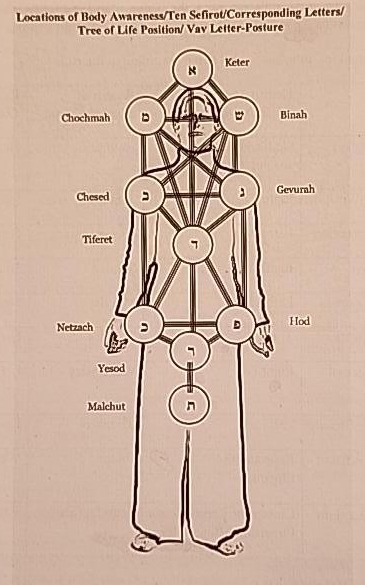
There is a correspondence between the mother letters and the three upper Sefirot, and the double letters and the seven lower Sefirot. An advanced practice in Ophanim is to study the meanings of the Sefirot and then briefly call to mind the name and basic meaning of the Sefirah at the start of doing the letter. The order is as shown in the diagram below. Note the twenty-two lines (related to the 22 letters) which connect the 10 Sefirot. Together they comprise the “32 Paths of Wisdom”.
Shin and Shiva: Hebrew-Hindu Connections
According to the Torah, Hebrew is the original language of Adam and all other languages are descended from it or systematically related to it. Much work has been done from the Renaissance onward to try to prove this thesis, including the recent work of Isaac Mozeson (see The Word) which makes a powerful case for the connections between Hebrew and English. Connections between Hebrew and Sanskrit, for example, are both intriguing and less manifest in an overall or quantitative sense. The standard system of verbal roots invented by the Sanskrit grammarian Panini to explain the forms of the language does not generally match up in a simple way in meaning or sound with the two and three letter roots of the Hebrew/Semitic languages. Still, there are some remarkable “coincidences” of meaning and sound in the two language groups concerning some basic concepts which lend support to the idea that Judaism and Hinduism share some kind of common root. The Sanskrit alphabet is said to be based on the Hebrew (MacDonell, A Sanskrit Grammar For Students, intro) which surely begs for some explanation.
The Hebrew Patriarch Avraham’s mission, it is said, was to put back into the world knowledge, once universal, which had been lost as a result of the events represented in the Torah as the stories of the “Flood” and the “Tower of Babel”. Some sources suggest a connection between the name Avraham and Brahmanism, the religion, and Brahmins, the priestly social class/caste of ancient India. Avraham and his wife Sarah are mirrored in the Hindu pantheon as the god Brahma and his female consort Sarasvati. The Torah states that Avraham (traditional author of the Sefer Yetzirah) sent certain “gifts” with his sons (by his late wife Keturah) to the land of the east. These “gifts” have been interpreted as lesser mystical teachings which were brought to Asia which could include such things as astrology, medicine, yoga and meditation, contrasted with the teachings of the Kabalah concerned with the science of the Hebrew letters which were transmitted only within the lineage of Avraham-Yitzhak-Yaakov-Yaakov’s Twelve sons (twelve tribes of Israel), as it says: (Genesis, 25:6) “Avraham gave all that he had to Yitzhak. But to the concubine-children who were Avraham’s, Avraham gave gifts; then he sent them away from Yitzhak his son while he was still alive, eastward to the land of the east.” The teaching coming from Avraham/Sefer Yetzirah speaks of the creation of the world by the Hebrew letters. Ancient Hindu teachings also speak of the creation of the world by sound, in a certain order, relating to the Sanskrit vowels and consonants. Whether this similarity refers to a connection with the Avrahamic tradition or to some other source, there is a basis for comparing the two traditions.
The Sefer Yetzirah is our earliest and primary reference for the Hebrew understanding of the role of certain letters/sounds in creation. We will start with the three figures (Trimurti) of the Hindu “godhead”, Brahma, Vishnu, and Shiva. (It is interesting to note that in Hinduism there is not such a conceptual difficulty or rather that there is a flexibility such that believers can at once profess that there is an absolute unity which transcends the gods and creation, while in everyday life they devote themselves to worshipping particular aspects of it.) Brahma is the creator. It corresponds to the Hebrew letter Bet, the letter which begins the creation of the world of time and space, corresponding to the first day of creation, the element of water, the first letter of the beginning words of the Torah, bereshit bara “in the (or simply–the) beginning created”. Vishnu is the preserver. It corresponds to the Hebrew letter Vav, which in the four letter name of God refers to the sefira of Tiferet, which is the letter that balances the right and left sides, upper and lower, the element of air. Shiva is the god of destruction and regeneration. It corresponds to the letter Shin, the mother letter for fire, which creates out of unity, the multiplicity of individual entities. As an Ophanim posture, the letter Shin is remarkably close to the representation of the god Shiva as “king of the dance”, Shiva Nataraja, standing on one leg, often surrounded by a circle of flames, with multiple arms outstretched. The parallelism of energy/functions of the three-fold godhead in Hinduism with the three-fold energies (water-air-fire) of the Hebrew letters suggests that the ideas were originally the same. On the one hand they are expressed structurally in the Kabalah as impersonal elements of a system of creation, and on the other hand have been personified and made into figures for worship in two Hindu devotional religions, Vaishnavism and Shaivism.
The second parallel triad concerns the three doshas or types of energy expressed in human body types, temperaments, and food in the ancient system of Ayurvedic medicine. These are called Kapha, Vata, and Pitta, corresponding to the elements of water, air, and fire respectively. These correspond in the Hebrew to the two opposing double letters Kaph (water) and Peh (fire) and to the letter Vav which as mentioned can refer to the air element which balances the two. One reason why the letters Kaph and Peh would have been used to name the doshas of water and fire as expressed in types of human beings, rather than the letters Bet and Gimel or Mem and Shin is that in the structure of the ten sefirot, Kaph and Peh are closest to the level of physical expression/earth element (the letter Tav).
The third parallel concerns the similarity between the group of “double letter” consonants in Hebrew and their counterparts in Sanskrit whose “doubling” consists in a stronger breathing transliterated as an added “-h” after each letter. In Sanskrit these “doubled” letters are written with separate characters. The six double letters–bet, gimel, dalet, khaf, peh, tav–are present in Sanskrit as: ba, bha; ga, gha; da, dha; ka, kha; pa, pha; ta, tha. Only the double form of resh (probably the most obscure of the double letters in actual usage) is missing its counterpart in Sanskrit letter ra. Sanskrit does, however, possess a vowel “ri” which has two forms, short and long.
Some additional similarities between Sanskrit and Hebrew roots and words are the following:
- smri, Skt for remember, be mindful; and sh-m-r, Heb for to guard, keep, remember, observe as in keeping the Shabat.
- bodh, Skt root, to awaken, later buddha, the “awakened one” and the way of awakening through meditation which is Buddhism; and b-d-d, Heb for boded, being alone, root for one of the standard terms for meditation, hitbodedut, and the prophets, mitbodedim.
- manusha, Skt for person; and enosh, Heb for person
- isha, Skt for “Lord”; and iish/isha, Heb for man/woman.
- amrita, Skt for immortality, combining the negative prefix “a-” with the word for death mrita; and emet, Heb for truth also based on the letter aleph-“a-” with the word for death, met.
- ananda, Skt literally meaning the “endless” but translated as bliss, one of three qualities of the Absolute–being-consciousness-bliss (sat-chid-ananda); and eyn sof, Heb literally the “endless” referring to the highest level of God, the unknowable source.
- vrit, Skt root, to become, turn; and b-r-a, Heb to create.
- The numbers 1, 6, and 7 – eka, shash, sapta in Skt; and echad, shesh, sheva in Heb.
- stha, Skt root, to stand; and tashtit, Heb. for basis, foundation.
- madhu, Skt for sweet; and matok, Heb for sweet.
- raksha, rakshasa, Skt for demon; rasha, Heb for evil, bad person.
- kapi, Skt for monkey; and kof, Heb for monkey.
- rajas, raga, Skt for passion, and ragesh, rogez, Heb for feeling, anger.
- kri, Skt root, to do, make, and kara, Heb for happening, (chance) occurrence.
- dyaus, Skt (Greek dios, zeus) Sky-god and Heb Divine name Sha-day (the aspect of God as immanent in creation), (by permutation from) sh-d-y → d-y-s(h)
The Palm Tree of Devorah
The Palm Tree of Devorah by the master Kabalist Rabbi Mosheh Cordovero is a short, perennial Jewish classic which explains the way in which man can emulate in his everyday actions and attitudes the qualities of the Divine Attributes, the Ten Sefirot. It is the main book of recommended reading for students of Ophanim and Prophetic Jewish Meditation.
Conclusion
The practice of Ophanim is presented as a gift to all those who desire to bring spiritual awakening, together with physical wellness, to themselves, and through themselves to the world at large.
The 27 forms called Ophanim are an embodiment of ancient “signs” designed to be intimately understood by the human soul. In fact, they are a tool of communication between the hidden realms of the soul and the physical realm of the body. The wellness that will result from the practice of Ophanim is derived by the marriage which unites the spirit with its symbolic earthly form, the body.
We pray that all our readers and all those who will engage in the practice of this ancient art, receive the blessing of ultimate health and joy. May the Creator who fashioned His world, and taught man with the sacred Hebrew letters, make you the recipients of His love. Amen.
About the Author
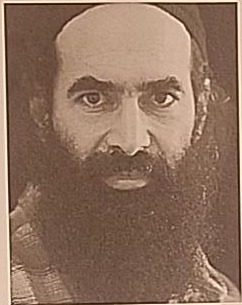
Zvi Zavidowsky has a B.A. degree in Religious Studies. His background includes studies of religions, philosophy, languages, meditation, martial arts, and naturopathic medicine. He began to practice Zen meditation at age 15, followed by immersion in the teachings of Gurdjieff and the Sufis for 20 years. He began to practice orthodox Judaism in 1985, eventually coming to Israel to learn and work. He returned to the U.S. in 1989 where he was initiated into a traditional system of Jewish meditation, as well as the teachings of Rabbi Nachman of Breslov. He later learned the practice of Ophanim. He started to teach in 1991 and has since taught workshops on Ophanim and Jewish meditation throughout the US, Canada, and England including the training of teachers. He and his family came to Israel on aliyah in 1999 where he is head teacher of the Nefesh Haya School.