Christ Yoga / Messiah Yoga · Ophanim Yoga
Browse the full manual
Basic Instructions
The whole soul (or all soul) praises the name Ya-H, Halleluh Ya-H
כל הנשמה תהלל יה הללויה
— Psalms of King David: last verse
Inner Exercise
Ophanim practice is a balance of “inner,” that is, exercises involving awareness and the renewal and circulation of internal energy, and “outer”, that is, exercises for the body which manifest that energy. It follows the advice of the Chinese teaching which says, “one who does external exercises must do internal exercises, but one who does internal exercises alone does not need to do external exercises.” It is important to grasp the concept that in Ophanim the “inner exercise” is more important than the outer, although it includes both kinds. The physical Ophanim postures that we do in the shapes of the various Hebrew letters are the outer exercise. These involve stretching, holding, balancing, opening, contracting, etc. the body. The “inner exercise” includes rhythmic breathing, mental vocalizing, and working with our attention, using the physical posture as the locus for directing the flow of awareness. This awareness itself is part of the inner dimension of what is meant by “doing” or becoming the Hebrew letters.
Essentials of the inner exercise in Ophanim
The “inner exercise” of Ophanim consists of three inter-related elements as follows, all done as much as possible with the eyes closed:
- to learn to breathe in a specific rhythm (“10/5”)
- to direct a flow of awareness through specific areas of the body (“Tree of Life”) synchronized with the breathing
- to hear in our mind’s “ear” (mantra) the mental calling of the sound “Ya-H” as we breathe and direct our awareness to the body.
It is recommended to learn all the parts of the inner exercise first, then learn to do the order of the Hebrew letter postures. This follows the understanding that the inner is primary for many of the benefits of Ophanim and can be done by most people, including those who may find the physical postures difficult. It is also possible to gradually learn the inner exercises starting with the breathing alone, going into the sequence of letters postures and gradually including the other steps of the inner exercise. Both approaches have been successful in learning Ophanim and realizing its benefits.
Breathing on 10/5
The breathing technique we call “10/5” is an essential part of Ophanim. In the system of the 10 Sefirot the Divine Name Ya-H is connected with the sefira of Chochmah-Wisdom. Chochmah is the first point of creation, the infinitesimal point which contains in potentiality the whole (completely in accord with the modern “big-bang” theory of the universe). As was quoted from the Zohar in the beginning of this book, the name Ya-H is what God breathed into the nostrils of Adam to make him a “living soul.” In the Torah, creation is continual, moment-by-moment. The Morning Prayer service includes a line about God which translates literally: “and in His goodness He makes new each day always the work of Creation.” The name YaH continues always to make everything from nothing. This normally occurs in nature and in man unconsciously. When we consciously do the technique of the breathing and the other aspects of the “inner exercise” connected with the name Ya-H we allow for our conscious mind to be renewed. To be like God we must always be in a state of renewal. In the line which concludes the Book of Psalms King David says: “the whole (all) soul (neshamah) praises the name Ya-H, halleluYa-h.” The Midrash (Bereshit Rabba 14) changes the reading of the word “neshamah”-soul in this passage to be “neshimah”-breath, teaching that “with each breath we need to praise God” (becal neshimah uneshimah tzarik lehallel et Hashem.) This is very likely an allusion in Midrashic times if not earlier to the practice of “breathing the name of God” which we are teaching here. Based on the numerical values of the letters, (Yud=10 and Heh=5) the 10/5 rhythm is the direct translation of the Divine Name Ya-H into the act of breathing.
To master this breathing pattern may take quite a long time depending on the individual. It is the key to renewing the vitality or life-energy (Hebrew: hiyut). The pace of counting the 10/5 depends on each person’s ability. Some start with quite a rapid pace. The main thing is to keep the rate the same for both inhaling and exhaling. Since the pace will naturally slow down with practice, one should not force the process, but let it occur gently in its own time. It is suggested for all to try breathing very gently at first. Take in a minimal volume of air and it will be easier to breathe in to the count of ten, and to empty the lungs fully on the count of five. With practice the breathing becomes longer and deeper. The practice of this breathing can be done for short periods of time anywhere that your schedule and surroundings allow, such as a mini-break in one’s workday. It is a way to become aware of God with your breath. Some healers have termed this 10/5 breathing the “Breath of God” and have used it while doing their work. It has also been of considerable help to several women who practiced it continuously, while giving birth, to maintain a clear and relaxed mind.
Important points to follow in doing the 10/5 breathing
The following points apply to this breathing (done as much as possible with eyes closed):
- Breathe in and out through the nose (not through the mouth).
- On each breath mentally count to ten when inhaling, then, without pause, at the same rate, count to five when exhaling.
- It may be a relatively fast count, but you need to keep the pace of counting the same for both inhaling and exhaling.
- Take in a minimal volume of air, so that it is both easier to reach the count (of ten) when inhaling, and easier to empty the lungs to the count (of five) when exhaling.
- Let the breathing be as gentle and effortless as possible.
- We do not specify the mechanics of breathing (as in: “try to breathe from the diaphragm or abdomen”). Let your body find its own way to breathe. In time the breathing will become deeper and longer by itself.
- You eventually will need to drop the mental counting, but stay with it at first until you can do the breathing rhythm on the feel of it.
- The breathing should be continuous, although a pause at the end of the exhalation is allowed before the next breath. No pause, however, should occur between the end of the inhalation and the beginning of the exhalation. Just as the letters Yud and Heh are considered inseparably married, so should the inhalation and exhalation be united without a break.
Directing Awareness through the Body
After becoming familiar and comfortable with the 10/5 breathing, we add the stage of body awareness. This awareness is directed along a pathway based on a scheme of ten locations (sefirot) called the “Tree of Life”. This scheme, simply stated, is a mapping of the various attributes or stages of the Creation. In doing Ophanim, we apply a form of this scheme to an awareness of the human body. The ten centers or stations of the “Tree of Life” have ten corresponding locations in the human body as shown in the diagram below.
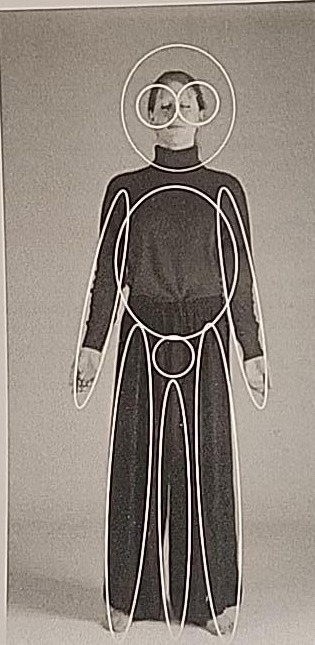
Ten Locations of Body Awareness When Inhaling
Focus your attention, with your eyes closed, on the body while inhaling (to the count of ten) according to the following sequence of ten locations:
- The skull and surrounding space
- Right hemisphere of the brain
- Left hemisphere of the brain
- Right arm
- Left arm
- Torso
- Right leg
- Left leg
- Genital area: for women the womb; for men the external genitals.
- From the genital area to the feet: for women from the opening of the womb (cervix) to the feet; for men from the crown of the penis to the feet.
Center of Body Awareness When Exhaling
Focus your attention while exhaling (to the count of five) on the heart area (which can expand to the chest) sensing the flow of energy from the heart out into space.
Important points for directing the awareness
The following points apply to the directing of awareness through the body:
- Allow the attention to “flash” on the ten locations of the body in order from the head to the feet.
- The directing of awareness follows the path of the ten locations in the body concurrently with the inhalation on the count of ten. (This can be described as shining a “moving mental spotlight” on each location as one is concurrently breathing to the count of ten.)
- With practice the initial direction of attention becomes a more self-sustaining movement of awareness/attention in a continuous flow (that has a sense of fluidity and subtle substance).
- A useful image may be to picture the body as an empty glass vessel. As we breathe in, we are filling that vessel with radiant light (our awareness) starting with the space of the head and proceeding to the feet.
With practice the directing of awareness through the body, creates a kind of dynamic, imaginal “light body” in the shape of each person’s actual physical pose. Along with the awareness is the sense of a flow of energy through the body. Each letter pose provides a different way for the flow of energy/awareness to be experienced in the body. For example, doing the “mother” letters, Aleph, Mem, and Shin, provides a powerful sense at the start of the dynamic range of the three basic energies: air, water, and fire.
Doing each letter provides a multi-dimensional experience of its respective creative element. Doing the letters in the combinations taught by the Sefer Yetzirah enables the practitioner to renew and balance those energies within him/herself, attuning with the universal letter combinations active at the time.
Mental Vocalizing
After learning the breathing and directing our awareness through the body with each breath, we learn the third essential step in the inner exercise: the mental vocalizing.
Important points for mental vocalizing
The details of the mental vocalizing are as follows:
- The mental vocalizing (Sanskrit: mantra) consists in learning to hear in our mind the sound “yaaaaaaaaaa” while inhaling and, without a break, the sound “hhhhh” while exhaling.
- Together the mental vocalizing will be a continuous sound “yaaaaaaaaaahhhhh” paralleling the 10/5 breathing rhythm.
- These mental sounds are similar to the sounds that can be heard, physically, as the body breathes. (For example, listen to the sound of your breath while covering your ears with the palms of your hands. You will hear a sound like the one which we learn to do mentally.)
- The loudness or softness, strength or gentleness of the mental vocalizing is up to the practitioner. You are invited to try the mental vocalizing in several ways, as there is a range of feeling possible according to how you do it.
- The mental vocalizing can be so powerful that you can actually feel the vibration in your body, including the continuing reverberation when you stop actively doing it.
The practice of this mental vocalizing helps to concentrate the mind and eliminate mental distractions. Doing the mental vocalizing provides continuous feedback on your progress with holding your attention on its task. It is taught that this particular mental sound itself is helpful to bring a new energy into the mind, while releasing the sources of mental noise, so that the mind can be more rapidly cleared of noise or accumulated tensions. This is something that can be experienced with moderate effort.
Letter Combinations
The Sefer Yetzira provides the structure for the practice of the Hebrew letters in Ophanim. The Hebrew alphabet consists of 22 regular letters and 5 final letters (which are a special form when the letter occurs at the end of a word). The Sefer Yetzira divides the 22 letters into groups of three “mothers”, seven “doubles”, and twelve “simples”. The charts below and on the following pages show the letter groups, their respective body postures, and the time to practice them:
Mother Letters — Practiced Everyday
| א | Aleph | Standing letter, one-leg balance, facing right/left |
| מ | Mem | Sitting letter |
| מ | Mem–Flying | Sitting variation |
| ש | Shin Front | One-legged letter |
| ש | Shin Side | One-legged letter, side variation |
Double Letters — Practiced on Specific Weekdays
| ב | Bet | Sunday |
| ג | Gimel | Monday |
| ד | Dalet | Tuesday |
| כ | Khaf | Wednesday |
| פ | Peh | Thursday |
| ר | Resh | Friday |
| ת | Tav | Saturday |
Elemental (Simple) Letters — Practiced on Specific Months
| ה | Heh–Moving | Nisan |
| ו | Vav | Iyar |
| ז | Zayin | Sivan |
| ח | Het | Tammuz |
| ט | Tet | Av |
| י | Yod–Moving / Yod | Elul |
| ל | Lamed | Tishrei |
| נ | Nun | Heshvan |
| ס | Samech | Kislev |
| ע | Ayin | Tevet |
| צ | Tzadi | Shevat |
| ק | Kuf | Adar |
Final Letters (Sofiot) — Practiced When Doing Respective Regular Letters
| ם | Mem Sofit | Everyday |
| ן | Nun Sofit | Heshvan |
| ץ | Tzadi Sofit | Shevat |
| ך | Khaf Sofit | Wednesday |
| ף | Peh Sofit | Thursday |
Basic order of letter combinations
The basic Ophanim practice is the enactment of the letters which are held to be active in the Creation at the time of the practice which includes both fixed and variable elements. The basic set follows this order:
Start with the letter Vav (nominally one of the simples-monthly letters, but in practice is always used to open and close each set.)
Always follow it by doing all the variations of the three mother letters: Aleph, Mem, and Shin.
Then do one of the seven double letters: Bet, Gimel, Dalet, Khaf, Peh, Resh, or Tav in all its variations, if applicable (according to the day of the week) and
Do one of the 12 simple letters: Heh, Vav, Zayin, Het, Tet, Yud, Lamed, Nun, Samech, Ayin, Tzadi, or Kuf in all its variations, if applicable (according to the month in the Hebrew calendar).
Do at least the Final Mem (and according to your ability other final letters which are related to the daily or monthly letters being done at the time)
Conclude with the Vav.
A Sample Practice is shown here
A sample practice for a Sunday in the month of Nisan (first month of Spring) would be as follows: Vav, Aleph, Mem, Shin, Bet (for Sunday), Heh (for the month of Nisan), Final Mem, and Vav.
Putting It All Together
The following points should be observed when you have learned to do the inner and outer exercises and are doing the basic or an extended Ophanim practice.
- One should generally do three to five breaths for each one of the letters. (This means that a basic set is typically 39-65 breaths long or about 15-25 minutes according to the length of your breath.)
- For the letters Aleph, Mem, Shin, Gimel, Resh, Heh, Yud, Ayin and Kuf there is more than one orientation or variation of the letter to do. When doing these, one should do the three to five breaths in all forms of the letter.
- One should try to keep the torso facing east in all postures. (This is because east is the direction connected with the letter Dalet, the torso, and the sefira of Tiferet.)
- When in need of treating special ailments, you can do the suggested letter for the relief of the ailment alone, or as part of the basic set.
- Always start and finish all sequences with the Vav (“Tree of Life” position) (see the figure above and on page 86). It is permitted and recommended to do the Vav as much as you wish during the set. Doing the Vav is helpful as a transition before doing the most difficult stretching postures (for example: Zayin, Tzadi, Resh, and Lamed) as it increases flexibility. Simply standing in the Vav position allows one to feel the cumulative effects of the various letters on the circulation of internal energy.
- Note that the inner exercise is in itself a powerful meditation and a unique form of prayer. When doing the basic Ophanim set try to maintain a continuous flow from one letter to the next with a minimum or no speaking or interruption. When practicing as a group, use a hand clap, for example, to signal the move to the next pose.
For your safety, comfort, and success in practice
Ophanim involves the unification of the physical, emotional, mental, and spiritual parts of a human being. Wherever you find it difficult to do the outer exercise/physical postures precisely as indicated, you should work out the best posture according to your own constitution or physical limitations. While you can expect to gradually stretch and gain more flexibility, the way you execute the postures should be optimally comfortable enough that you can simultaneously work on the inner exercise. The inner exercise as a whole activates the connection to the root of the Divine Source within and carries a higher priority in the practice of Ophanim.
Medical Benefits
Please note that the “medical benefits” ascribed to the letters in the next four chapters are based on a compilation of many classical commentaries on the Sefer Yetzirah. The author presents this information as part of the traditional teachings which relate the creative “message” of the Hebrew letters to the health of the body and soul, and not as a substitute for qualified medical care or advice in cases of disease.