Christ Yoga / Messiah Yoga · Ophanim Yoga
Browse the full manual
Yud — Monthly Letter, Elul (Sitting and Moving Letter)
Attributes
The Yud is the smallest of all the Hebrew letters, and is therefore the root of all shapes for the other letters. To write any letter, one necessarily starts by writing a Yud, which is merely a dot. It is the primary life energy, the source of wisdom, and is the point at the center of the head which is the focus of the 10/5 breathing meditation. The Yud is the first letter of the name of God, and corresponds to the number 10.
The Yud is connected with the third month of summer, Elul, and corresponds to the zodiac sign of Virgo. It is the second level of Earth.
There are two forms of Yud: sitting and moving.
How to do the letter
Sitting Yud
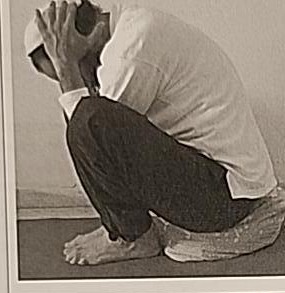
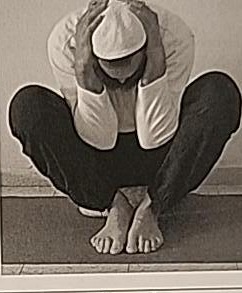
The still Yud resembles sitting in a fetal position. One begins by sitting on the floor, with legs bent, feet together and knees apart. Bend the head and back forward, covering the ears with the palms of the hands on each side of the head. Try to bring the elbows together so that they are touching, then enclose the elbows on either side by the raised knees. The head is turned down with the chin gently against the chest, so that the eyes could be in line with the navel. The intent is to focus the energy of the head into the abdominal area. Finally, the aim is to compress and hold the body from front to back (back and head leaning forward and heels of feet drawn in toward perineum) and side to side (knees pressing in on elbows). When you have settled into a personally comfortable position, do the inner exercise 3-5 or more times. It is strongly advised to do the Yud with a cushion under the sitting bones to avoid and ease tension in the back.
Benefits
Doing the sitting letter Yud has these benefits: healing of the kidneys, overcoming depression and procrastination, and intrauterine awareness.
Moving Yud
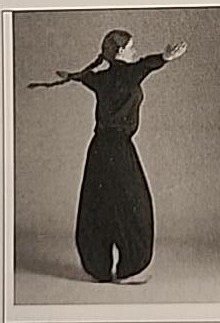
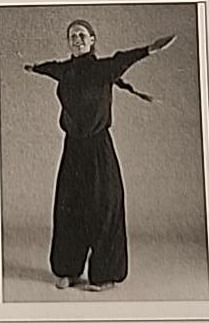
The moving Yud (or whirling Yud), starts in a standing position with arms extended loosely out to each side, parallel to the floor, with palms facing upward. In a circular motion, leading with the right arm and hand, rotate the entire body first five complete turns to the right and then, leading with the left arm and hand, rotate five complete turns to the left. Try to keep your feet close to the same spot as you turn. The intent on each rotation is to focus mentally on one of the corresponding ten body parts, mentally vocalizing “Yaaaaa”. All ten rotations are done in one inhaling breath. After the last rotation, come to a complete stop, and exhale, focusing on the chest, on the count of five, mentally vocalizing “Hhhhhh”. Do the moving Yud 3-5 times.
Benefits
Benefits of the moving Yud are the opening of the channels of all the ten points. It brings in a whole influx of new energy.
Caution: Be careful not to practice the moving Yud more than ten times sets in one session.
Many people experience dizziness at some point doing the moving Yud. Try doing it with the eyes open focused on a particular spot or with the eyes closed to see what feels the best. With daily practice in the month of Elul or at other times, it will become much easier and enjoyable.