Christ Yoga / Messiah Yoga · Ophanim Yoga
Browse the full manual
Aleph — Mother of the Standing Letters
Attributes
Aleph is the first of all letters and has no pronunciation of its own. It is the beginning of all vocalizations. The root-letters of the word Aleph (aleph-lamed-feh) include the meanings: master, to teach, ox, and thousand. In the word for man, Adam (aleph-dalet-mem), the aleph stands for God. Its shape indicates unity between Heaven and Earth. It is the number one, and among all the letters, the one most representative of the Divine. Aleph is the root of the Air element. The written letter Aleph is said to consist of three smaller letters: two Yuds (one above and one below) and a Vav (the diagonal line). For Yud understand “Yad” (Hand), one hand reaching up to heaven (fire) and one hand reaching down toward earth (water/earth). The Vav (air) formed by the rear leg and torso is the line between them which connects and maintains their balance. By this construction the written letter Aleph contains within itself a complete picture of the creation (representing all three initial elements) plus the symbolic message of what it does, namely as the air element, to connect and balance the elements of fire and water.
In relation to the Ten Sefirot, Aleph corresponds to Keter-Crown. In the human body it corresponds to the skull and the space around it.
There are two variations of the Aleph: facing left and facing right
How to do the letter Aleph
Facing left
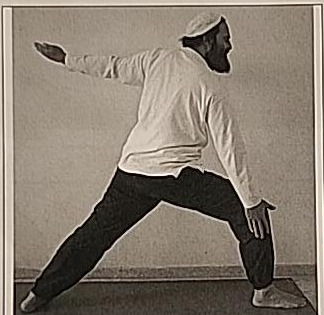
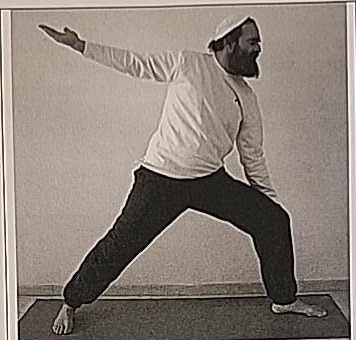
To do the Aleph position one should first stand facing south with the feet parallel and legs comfortably wide apart. Turn the left foot out 90 degrees, then turn the face and the torso to the left (east) and bend the left knee not more than 90 degrees (with the knee over the ankle). While keeping the right leg straight, place the left hand at or below the left knee on the outside of the leg. Try to keep the hips squared with the south wall while turning the torso over the waist to face east. Keep the torso in line with the straightened right leg. The head should be in line with (or lifted a bit above) the diagonal formed by the rear leg and torso, eyes looking straight ahead. The right arm and hand are extended to the right with the palm facing upward to the heavens at the same level as the head (see illustration). In this position, do the inner exercise for 3-5 breaths. Be aware of making the connection between heaven and earth as you breathe through the ten parts of the body. Feel the expansion of your breathing while doing the Aleph.
Facing right
To do the Aleph position facing right one should first stand facing north with the feet parallel and legs comfortably wide apart. Turn the right foot out 90 degrees, then turn the face and the torso to the right (east) and bend the right knee not more than 90 degrees (with the knee over the ankle). While keeping the left leg straight, place the right hand at or below the right knee on the outside of the leg. Try to keep the hips squared with the north wall while turning the torso over the waist to face east. Keep the torso in line with the straightened left leg. The head should be in line with (or lifted a bit above) the diagonal formed by the rear leg and torso, eyes looking straight ahead. The left arm and hand are extended to the left with the palm facing upward to the heavens at the same level as the head (see illustration). In this position, do the inner exercise for 3-5 breaths. Feel the expansion of your breathing while doing the Aleph.
The Aleph is practiced every day.
Benefits
This exercise is helpful in aligning the spine and opening the ribcage to allow freer breathing. It focuses the mind and calms the spirit. Try it when you first arise in the morning to awaken your mind quickly.
Additional Points to Note
The Aleph can be a bit hard on the knees at first and beginners are advised to start with a form of the pose that is quite easy and comfortable, or by doing the poses in shorter sets. With time you can aim to increase the stretching and strengthening aspects of the pose. This is done by gradually widening your stance and bringing the fingers of your forward hand closer to your ankle or to the ground.
Aleph as letter posture and structure of sefirot
The Hebrew letters can be seen as configurations of sefirot. Each of the ten sefirot located in the body has itself a structure of ten inner sefirot. For example, in each of the arms and legs there are ten inner sefirot with the hands and feet representing the upper end of the structure, the “head” aspect. Where one puts one’s hands and feet is where the mental focus tacitly resides without the necessity of consciously thinking about it or directing one’s attention to those places. In the act of placing the hands and feet in a certain position, corresponding to the shape of the Hebrew letter, one is making a pattern of these inner sefirot. We use the “spotlight” of our conscious mind to bring more light or energy to flow through this pattern.
The following shows one model of how the initial configuration of body awareness in the inner exercise, the ten sefirot in the letter Vav, becomes reconfigured in the Aleph posture.
(In the printed book, this section includes a diagram comparing the ten sefirot mapped onto the written shape of the letter Aleph and onto the body in the Aleph posture — captioned “Sefirot within the letter Aleph” and “Sefirot within the Aleph posture.” We’ll bring this diagram into the site in a later pass.)