Christ Yoga / Messiah Yoga · Ophanim Yoga
Browse the full manual
Resh — Weekday Letter, Friday (One-Legged Letter)
Attributes
The letter Resh is practiced on Friday, the day of Yesod-Foundation.
Resh is connected with the attribute of Yesod-Foundation, and with the opposite qualities of peace and war. It is pronounced like a Spanish “R”. As a word, the letter Resh means “the head”. Symbolically, Resh represents the attribute of Chochmah-Wisdom, which is related to the head. However, we find it here in the weekday structure, in the place of the attribute of Yesod-Foundation, the generative principle, whose place in the body is the sexual organs. This connection between Chochmah-Wisdom and Yesod-Foundation can be explained in this way: since it is Divine Wisdom which gives life to all, it truly decides what soul should be reincarnated as a result of the union between a certain man and woman. This union happens physically through the activation of the Yesod-Foundation principle. Although it may seem that the parents’ desire alone has caused the soul to descend into their child’s body, it is actually decided by the Divine Wisdom, who alone chooses when and where it is propitious for a soul to be incarnated. G-d is the sole conceiver of all beings.
In the Sefer Yetzira Resh is connected with the sixth day of the week, the direction “west” and the left nostril in the human body. Resh is the second generation from the Air element. Its planet is Saturn.
In relation to the Ten Sefirot, Resh corresponds to Yesod-Foundation. In the human body it corresponds to the genital area.
There are two variations of the Resh: left and right.
How to do the letter
Standing on the left leg
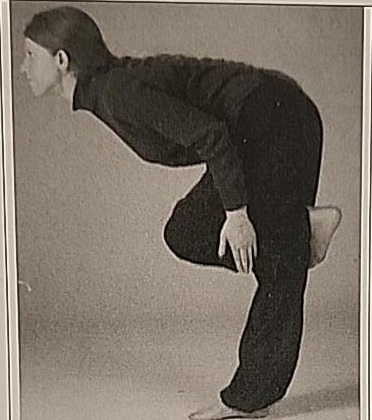
To do the Resh, stand upright with legs joined and with the arms down alongside the body. Then bend down (“flat-backed”) until the torso is at a 90° angle with the legs, bending the arms at the elbows so the upper arms conform to the angle of the back, and the forearms and fingers point down to the floor. Then lift up your head up, looking forward. As in doing the Shin, lift up the right foot and put it behind the left knee or calf, standing first on the left leg, with the right knee facing towards the front. Do not lock your left knee. Then go into the inner exercise for 3-5 breaths. It is suggested to do the letter Vav for a few breaths as a transition before and between the two variations of the Resh.
Standing on the right leg
Start as before, but lift up the left foot and put it behind the right knee or calf, standing on the right leg, with the left knee facing towards the front. Do not lock your right knee. Then go into the inner exercise for 3-5 breaths.
When you have become familiar with doing the Resh, you can include an additional mental focus on the left nostril while doing the basic inner exercise.
Benefits
Benefits of doing the letter Resh include: peacefulness, better eyesight, relief from back pain and sciatica, greater learning ability, and memory.