
Christ Yoga / Messiah Yoga · Ophanim Yoga
Browse the full manual
Heh — Monthly Letter, Nisan (Standing and Moving Letter)
Attributes
Heh is the first of the elemental letters, mystically symbolic of the feminine as the Mother, the Wife, the Sister, or the Daughter. Heh is the letter of breath itself, as its pronunciation suggests. This letter is the feminine attribute and the root of life and breath in this world. It gives birth to speech, an activity inseparable from breath. The numerical value of Heh is five which refers to the five divisions of the Hebrew letters according to where they are formed in the throat and mouth when pronounced.
Heh is connected with Nisan, the first month of spring, and the sign of Aries. It is the first level of Fire. Heh is pronounced H as in “house” or “horse”.
There are two forms of Heh: standing and moving. The standing Heh has two orientations: right and left.
How to do the letter
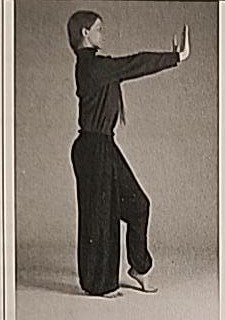
Standing Heh, right orientation
To do the Heh, in its still form, is to do the Dalet (exactly with arms outstretched, and with tension in the fingers toward the face) combined with the leg-stance of the Gimel. Start by standing with the feet together, then shift your weight entirely onto the right leg with the left leg bent at the knee and the left foot resting lightly on the ball of the foot. Then raise your arms in line with your sides, keeping them straight, until they stand at a 90° angle to your torso. Have your palms facing ahead of you and extend your arms as if you are pushing against a wall. Then bend the fingers back toward your face and hold them there. In that position, do the inner exercise 3-5 times.
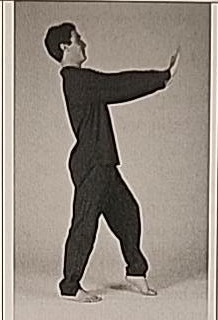
Standing Heh, left orientation
Start as before standing with the feet together, standing on the left leg, then shift your weight entirely onto the left leg with the right leg bent at the knee and the right foot resting lightly on the ball of the foot. Raise your arms as before. In that position, do the inner exercise 3-5 times.
Benefits
Doing the standing Heh gives the combined benefits of Gimel and Dalet, including healing of the liver and strengthening of speech.
Moving Heh
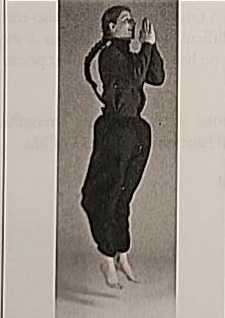
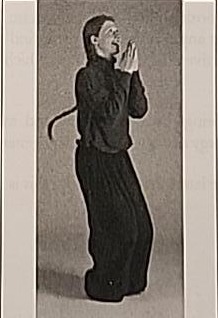
To do the Heh in its moving form is to jump up, springing up a total of four times during which you inhale in one continuous breath (to the count of 10), and then stand relaxed, exhaling to the count of 5. While in the air, for each of the first three jumps, clap your hands three times quickly in front of your face. Finally, on the fourth jump clap only once. Now relax and exhale. The total number of claps is 10. There are 10 claps for four jumps. It is suggested to practice several times the breathing with the clapping while standing to get the rhythm of the exercise, then add the jumping.
This exercise is quite vigorous. With time, one becomes able to focus on the related ten parts of the body during the ten claps, focusing on one part per clap, and the mental vocalizing. Do the moving Heh 3-5 times. Taste the joy of doing the moving Heh!
Benefits
Benefits of the moving Heh are rejuvenation and invigorating of all body channels.